

An Empty Spectacle
Trump's SOTU speech will do nothing to arrest his slide, while Carville challenges him, mano-a-mano, to recognize that he's a losing "sack of shit" being stabbed in the back by his minions.

I didn’t watch Trump’s SOTU last night, and I guess I hope that you didn’t either. I only had a couple of notions about it beforehand—one was whether Trump would come unhinged in some noticeable fashion. There have been segments from some of his recent public performances that are really quite startling, and I wondered whether he might treat the national audience to one of those mental excursions that have more than sixty percent of Americans saying in a new Reuters/Ipsos poll that the president “has become erratic with age.”
That possibility was the only reason I thought of watching, and it didn’t happen, at least from what I can see in today’s coverage. And it doesn’t matter anyway, since the speech itself will be forgotten by the end of the week. Maybe the most useful takeaway is that Trump gave less than nothing to the Republican candidates hoping for something they can say about the economy, besides “affordability” being a Democratic hoax.
My other notion had nothing to do with anything but a sort of wish-fulfillment fantasy. I was remembering the fall of Ceausescu in 1989, when the Romanian dictator had assembled a huge, carefully staged rally of ostensible supporters, bused in from regions outside the capital, for a speech that would demonstrate his continuing popularity in the face of protests and brutal repression.
Things started well enough, until about ten minutes in there was some sort of commotion in the crowd of 100,000, and people began chanting “Timisoara,” the name of a Western city where a protest had been suppressed by security forces with widespread casualties and death. Taken by surprise, Ceausescu tried to calm the crowd, but without success—he had to be hustled from the stage.
The rally had been broadcast live, so everyone in Romania saw the dictator forced to flee the angry crowd. Widespread protests broke out later that day and into the night, and the next day security forces began to defect and Ceausescu and his wife were forced to flee by helicopter. Captured later that day, they both were subjected to a brief, improvised trial and then executed by firing squad on Christmas Day.
Let’s leave out the wish-fulfillment part of this nostalgic memory, since the piece I was actually thinking of is what happens to dictators and wannabe dictators when the populace finally turns on them. The sheer hatred and thirst for vengeance within Trump’s opposition exceeds anything we have seen in American politics, since the ante-bellum era at least.
The anger is righteous, since Trump is trying to destroy what is good about the United States and replace it with an oligarchic authoritarianism, and his racism, xenophobia, transphobia, sexism and misogyny are features, not bugs, in the movement that brought him to power. The Republican Party now has a Nazi wing, and some of those folks post propaganda from the White House.
The vengeance is righteous, too, if one defines it in terms of legal jeopardy and professional standing. When Democrats control the government again, they will face the question of what to do about all of the law-breaking under Trump. One expects that there will be more urgency to that project, when it finally begins, than there was in 2021.
But the hatred is more than that. People like me really hated Richard Nixon, that sniveling, hypocritical, crypto-fascist creep, but it wasn’t really that personal. There’s never been a president as capable of evoking visceral emotions, like abject adoration or intense hatred, as Trump does. That’s what made me think of the fall of Ceausescu.
*
Browsing around this morning to see if I could find anything int,eresting about last night’s speech (and basically failing), I ran across a piece in the opposition tabloid, Raw Story, reposting a 5-minutes video James Carville had made, posted to X by Mike Sington:

.
After learning that some videotaped commentaries ostensibly by George Will had been created by someone using AI, I am slightly skeptical of this clip, though Sington’s bio (retired NBCUniversal senior executive and cultural commentator with 147.5K followers) seems reputable. It could be fake, but if it is we’re all in trouble, since it certainly seems entirely authentic.
I’ll encourage you to watch the whole thing. Carville starts by saying “Now, I have a personal message for Donald John Trump, and--you sit still, you sorry son-of-a bitch when I’m telling you this, I’m going to tell you right where you are, you fat sorry sack of shit: People hate you.”
Carville calls Trump out directly through the entire screed, and he prefaces it all by saying that it’s not personal with him, he is just telling it like it is. The clip is five minutes of excoriation and loathing, and Carville’s basic message (watch the clip!) is that everyone hates Trump, including all of the people around him—everyone but Stephen Miller.
“I’ll give you that one,” Carville says, before shifting to say that even Jean Pirro has abandoned him, giving up on his order to prosecute the six Democratic legislators, all former military, who made the video about not having to follow illegal orders.
Carville is a skillful man, whose command of earthy invective projects the sort of power that Trump’s own buffoonish insults never could. It appears to me that Carville assumes, perhaps rightly, that Trump will have to watch the clip if he hears about it. The entire video seems expertly designed to get inside the president’s head and play on his worst fears.
Still assuming this all is real, not AI-generated deception, it seems to me that Carville understands Trump’s psyche as well as anyone might—he knows what a fundamentally weak man Trump is, an ego so fragile it needs constant reassurance and a man so friendless that he surely must understand that loyalty to him is only purchased, not freely given. Can he really trust JD Vance?
It’s hard to imagine the clip not working on Trump, if he happens to see it. Part of it is the way Carville crosses a line—this is a personal, mano-a-mano sort of insult, like Carville’s calling Trump out, looking for a bar fight and completely confident he’ll win. Part of it is, as I think Carville’s adduces correctly, that Trump is secretly afraid that all the things Carville says about hatred, loyalty, and betrayal are actually true.
It made me think of a little reported but very strange utterance of Trump’s at the beginning of the Governors dinner last Saturday, an event into which Trump more or less shambled, led by Melania, who did the handshaking for him. Trump opens his speech with an aside about his movie star wife, how she had asked him who would be at the dinner.
“Well, they’re all governors,” Trump says he told her, “and we have a couple of cabinet members so you can probably include them, and every time they look in the mirror, every time they go to sleep, or wake up, they look in that mirror and say ‘I should be president, not him.’”
Trump goes on to say “despite that, it’s a really friendly group,” but it is the small strange smile he gives before that, something between a grin and a smile with a lot of strangeness behind it, that really struck me.
Paranoia, or more precisely, “transient, stress-related paranoid ideation,” is one of the core symptoms of borderline personality disorders, and it is certainly a common trait among dictatorial leaders—with good reasons, generally speaking. Trump intended the line as a standard “loosen the crowd up with a joke” opener that every speech-giver knows to give, but the inclusion of “a couple of cabinet members” is really strange.
Carville knows and understands Trump’s paranoia, and he plays on it from the very start. “First of all, everyone is stabbing you in the back,” Carville says. “You can trust no one.”
Carville then highlights last week’s leak from within Trump’s administration, that Armed Forces Chief of Staff Dan Caine had warned Trump that any major strike on Iran carried significant risks and no clear likelihood of success, and also would create significant strategic risks in terms of drawdown of munitions and impaired strategic readiness in other potential conflict zones.
The story, which ran first in the Wall Street Journal and Axios, was widely picked up, in part because the initial reports triggered a vehement response from Trump on Truth Social, denying that “Razin Caine” had shown any reluctance on what any reasonable observer knows would be a grave risk taken for reasons and purposes that are entirely unclear.
It’s not clear where the leak came from, in part because it could have been anyone, and Carville’s use of it as the first salvo in his litany of potential betrayals would certainly catch Trump’s attention. There are others on the list—Susan Wiles, Congress, Jean Pirro—but Carville is especially good on the Supreme Court, which he says used Trump to get where they are, and now have abandoned him.
The point is strong, because whatever Trump’s hope for the 6-3 majority might have been since they gave him immunity from prosecution, the tariff decision is just the first in what will likely be adverse rulings on two other tests of presidential power, in trying to fire Lisa Cook from the Federal Reserve, and the Birthright Citizenship case. The court had already delivered a dispositive ruling on the deployment of National Guard troops, which were forced to pull out of Chicago, Los Angelas, and Portland, Ore.
Part of the fascination of Carville’s performance, for me, is the way he talks to Trump man-to-man, as two fellows who know how things work. When Carville dismisses Pete Hegseth and Mike Johnson as weak and useless tools, he’s saying it like he knows Trump had to feel the same way. The whole business is couched as “look, man, I’m just telling you how it is, you’re a loser.”
*
I’m not trying to make a story out of this—as I say, for all I know the thing is AI and Trump may never see it in any case. But what’s interesting about it is that everything Carville is saying is basically true, and Trump has to know it.
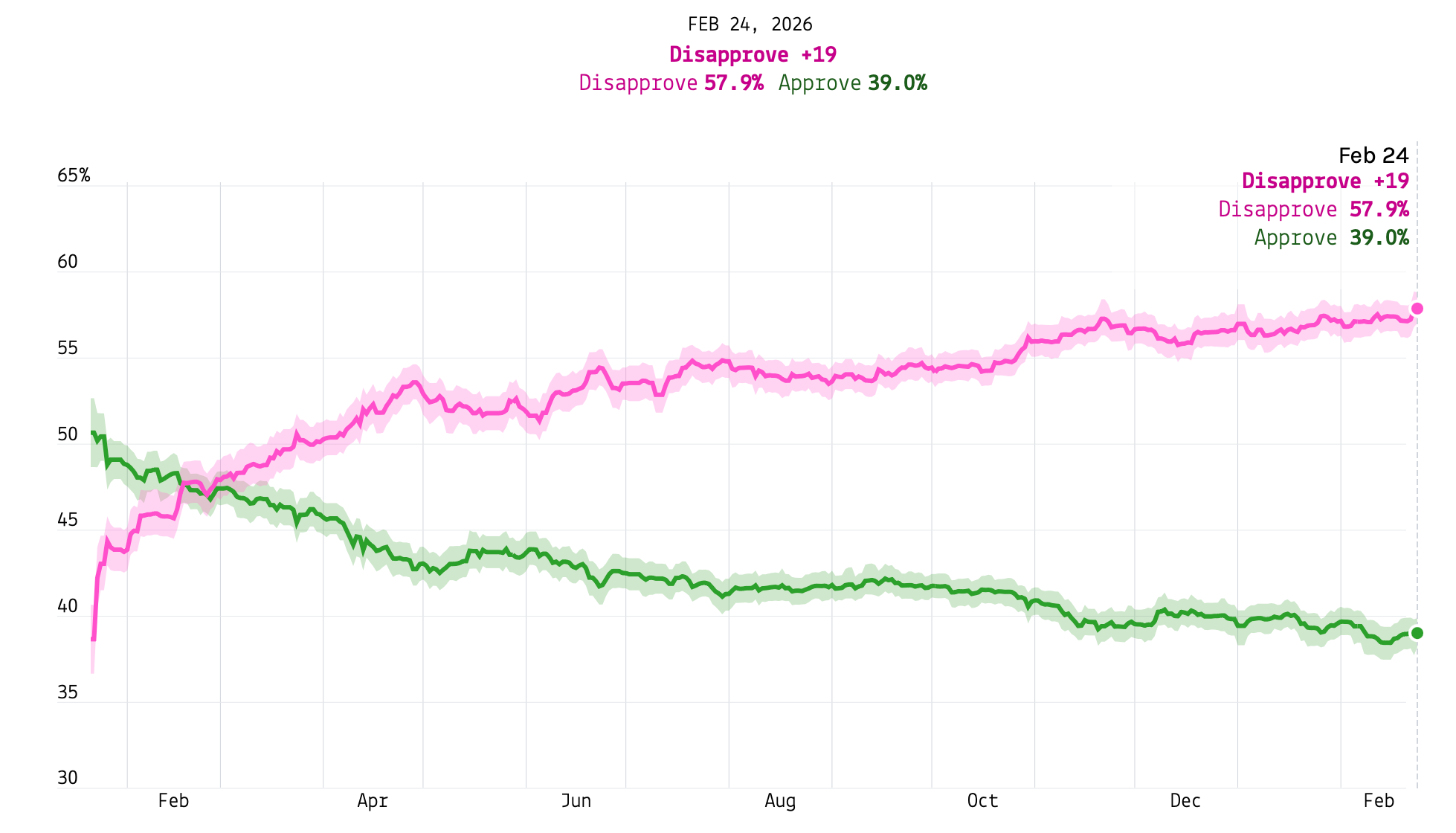
Even the level of vehemence and disdain is an accurate reflection of current polling, where 46 percent of people strongly disapprove of Trump and think Biden was a better president. As Carville says, Trump is the least popular president in American history.
Trump’s popularity has always had a ceiling, with approval never reaching 50 percent. It has always seemed that he had something of a high floor, too, at about 35 percent. Even after Jan. 6, 34 percent still approved of his presidency.
He’s nearing that point now, and all the signs continue to point toward a substantial Democratic victory in November, likely winning the House and with a much better shot at the Senate than anyone imagined a year ago.
To say that Trump has run out of options at this point is not entirely accurate, since there still is time in which Trump could respond to popular opinion and reverse some of his most unpopular policies, like letting go of his tariff obsession and declaring victory on the closed border and ending Miller’s ethnic cleansing campaign.
He’s made it clear that he won’t do that, doubling down on tariffs and duping the mainstream press into thinking that things in Minnesota were resolved, rather than the state of siege that still exists there. The next step for Trump is war on Iran, with Chekov’s gun on the wall already there, and the second act ready to begin.
The stakes are too high now for a simple one-off bombing raid, and Iran’s leaders are prepared for war, apparently preferring that to yielding to Trump’s extreme demands. Iran’s regime relies on terror to suppress dissent and it is a bad actor everywhere in the Middle East, but there is no evidence that a U.S. attack will improve the situation, and Trump has yet to offer a rationale in any case.
It’s not clear exactly how Trump is thinking about the mid-terms, and that’s why what basically amounted to a psy-op by Carville is so interesting to me. If Trump were a rational man, he would be focused right now on trying to help Republicans win, but he won’t even stay on script.
A number of outlets reported on a staff summit meeting last week focused on the mid-terms in which the decision was that Trump would just do what he wanted but everyone else needed to maintain strict message discipline, mainly on the economy. Trump’s SOTU gave Republicans nothing much to run on, besides the Men’s Olympic hockey team and invective against the Democrats.
As Timothy Snyder pointed out today in his Substack, Thinking About…,Trump’s fascist script offers just two options now: a victorious war against Iran, around which he can unite the populace, or a whole-sale rigging of the elections (or cancellation because of war.) Neither of these will work.
*
Perhaps the most obvious thing one can say about last night’s performance is that it was all spectacle, no substance. That seems like a good preview of what we can expect from Trump in the coming months, as his entire project continues to erode, culminating in what seems likely to be a definitive repudiation in November.
Thinking about Ceausescu, and about Carville’s screed, and about Trump’s own fragile, disordered psyche, I wonder just what sort of spiral we may find ourselves in as spring turns to summer and then fall comes with its reckoning.
We’ve never had a president as crazy as Trump, not even Nixon at his drunken extreme was as dangerous as this man is, and there were adults in the room back then. That’s not true this time around with Trump. Ceausescu’s fall is a metaphor—there’s no imaginable literal analogy there. But has any public figure ever been as hated as Trump is? The people who voted for him were voting for a winner. I wonder how they’ll feel when they find out he’s the biggest loser of all.
Gee, I was counting on you to watch for the rest of us! I looked a little and I thought the most gripping thing was watching the (un)changing looks on the faces of Vance and Johnson, although Johnson looked a little more sleepy. Yeah, Carville's screed could be AI but it's odd how it doesn't matter because except for the profanity which felt a tiny bit over the top even for him, everything he says is probably true. And the most realistic and scary part is the bit about Iran...