

Notes on Travel
A long, rambling, and ultimately inconclusive essay about nations, culture, and identity

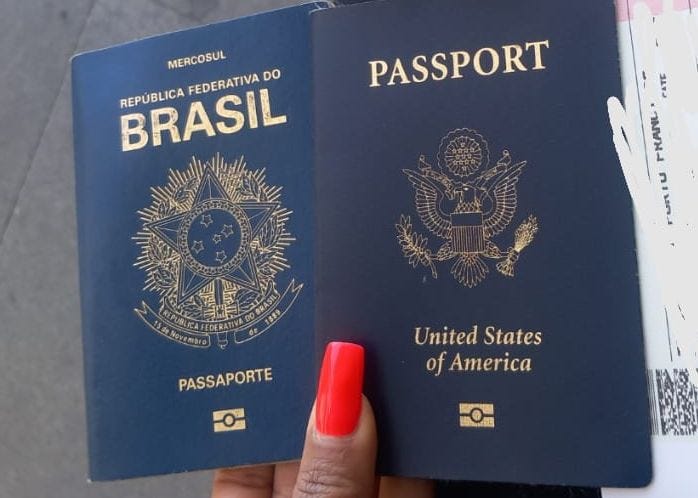
On Friday my partner and I start a two-month sojourn in Porto, with a side trip to Spain and maybe to Cabo Verde if we feel ambitious, an escape from winter here and a chance for me to reset my creative energies. We made the plans last October, before the war and the fires, which I hope will be out before we get to Madrid in September.
The last four years have been quite the journey for me, and last week I received my Brazilian residence card, marking a sort of completion. This trip feels like a benchmark, a time out before I return to resume my Brazilian life—the rest of my life-- in earnest.
For weeks I have been working on two long essays—one about geopolitics and scenarios for what may happen before 2028, and the second about the Democratic Party’s internecine conflicts and what they mean and don’t mean. I drowned myself in research, both essays deeply depressed me, and I am temporarily abandoning them. You should be grateful.
The war news is just bad, not just because the U.S. lost and now can’t extricate itself, but because it seems likely cause or exacerbate so many other problems—from famine in poor nations to a collapse of the AI stock market boom in the states. The U.S. under Trump did not just abnegate its role in the world. It has now become the kind of nation that the U.S. used to exist to counter and mediate.
You can say what you like about American imperialism and I will agree with you, but you’re going to miss it when it’s gone. As a resident of a proud BRICS nation, I can see why deglobalization might look good, but it is inefficient and getting from here to there will be about conflict more than cooperation. Hard times ahead.
It seems now that the best thing that can happen now is for Trump to declare victory and pull out his ships, and let the world economy settle back to some sort of new normal. The only alternative keeps the Strait closed indefinitely, with devastating global consequences.
And I don’t think that the Democratic party will get it’s act together in this electoral cycle, though it could and I hope that it will. It’s an inter-generational conflict, and the kids are really angry at the parents, and rightfully so. They fucked up. Instead of open primaries in 2016 and 2024, they tried to control the outcome and we got Trump instead. And I don’t think that the 2028 primaries will settle anything.
My analysis, as I and others have written before, is that the best analogies are 1932 and 1976—the same need for a new governing paradigm. It’s an opportunity for failure as much as success. The party’s brand is broken and there’s no real chance of renewal until it is able to achieve basic unity about what the party stands for and who it serves.
I don’t see this happening in the next couple of years, though its not hopeless. The reason I felt dispirited and decided temporarily to abandon this second piece is that current political discourse within the party and as framed by various pundits seems both bitterly divided and fundamentally trivial. Maybe that will change after the mid-terms, but I doubt it.
In any case, I was hoping to finish those two pieces before we leave for Porto but that’s not going to happen. Instead, I want to share a few things that are on my mind, thinking about nations and cultures and my own identity as I prepare to travel.
*
One thing on my mind a lot is the question of nationality and what it means to be a U.S. citizen—an “American,” as we like to call ourselves. It has been on my mind in various ways, thinking about whether I want to go for citizenship here, what it would mean if I shed my U.S.-centric perspective in this kind of writing, what it means to be an American in the world at a time when the U.S. is a malign force in the world.
The latter gets sharpened by travel, since the best one can feel is embarrassed to be an American right now, or ashamed. We really are a renegade nation under Trump, as lawless as Russia in our conduct, and it’s no wonder much of the world prefers China these days, even though China has its own interests at heart and makes no bones about it.
In Portugal it’s no big deal, since we’re a Brazilian couple there and I get by in Portuguese well enough these days. I can just blend in. It just feels strange to think that I will downplay my citizenship, should it come up, like “well, I am a U.S. citizen but I live in Brazil now (so don’t blame me.)”
I think about my perspective in this newsletter, where I clearly operate from a U.S. mindset, concerned about what is happening in my homeland. If I wrote from a Brazilian perspective, my essays would be different. I would be writing about the great power conflict between China and the U.S., and how Brazil stands to benefit from a judicious balance between the two while expanding its leadership within the BRICS middle powers.
Brazil has a lot of problems, more than the U.S. by any reasonable measure. It is a vastly inequal society in which nearly everyone is poor—my social security income ($38K per year) puts me in the top one or two percent here, although the actual rich are far richer than that.
The geographic and cultural structure of the favelas in Rio, Sao Paulo, Salvador, and some other cities is a direct legacy of slavery and how it ended. The problem of organized crime, which extends far beyond drug trafficking, seems intractable.
Bouts of urban warfare are a common occurrence in Rio, where we spend a lot of our time. Corruption, crime, and scam-artists (or golpistas here) all seem endemic, and they make for a low-trust society. Through my entire bureaucratic journey, which included investing in two properties, I used a great firm run by an Aussie and his Brazilian wife, a lawyer, and their constant injunction was to trust no one.
For all of that, it is an amazing country, and I am struck that all of the Brazilians I know are proud of it—even though many of them, including my partner, experienced a level of poverty when young that is far beyond anything I have ever heard of in the U.S.
Some of that may have to do with how distant the rich are here, and how much everyone else is basically in the same boat. I don’t know. It’s not that wage compression is a good thing, since opportunity feels so limited. But there’s not the same kind of envy and anger.
It’s just a different vibe here, even with politics as divided as they are, and all the various social tensions and maladies. The guaranteed minimum income (the bolsa familia) and pretty good universal healthcare, open to everyone including foreigners, probably has a lot to do with it. A shared love of futbol and samba. Public beaches that seem as democratic as the New York City subway system.
Being Brazilian would be cool with me, but I’m not. But I don’t feel very American anymore, either. The same thing happened to me when I was young and lived in the Philippines for a couple of years. Reagan was president and Marcos was a U.S. client, and during the period of the stolen election and the revolution I began to feel a sense of national pride sometimes, singing along to Ang Bayan Ko and remembering the fallen martyr, Benigno Aquino Jr., whom I had met and interviewed just weeks before he was assassinated.
I was young, and quite stupid then, and I was just drawn to a different life, not seeing how my own presence in it as the rich colonialist—quite literally, since it was still basically a colony then—shaped everything around me. The same is true here, although my presence is less obtrusive than it had been in the seaside village where’s I had lived on Mindoro. And I am aware of it and try to account for it in how I live and how I write about Brazil.
*
Being in different cultures makes me think about how much of my own identity is actually American, as opposed to something else—or that it is American in a way that doesn’t exist in the U.S. anymore. That’s not romanticizing—I just feel lucky that I grew up in Manhattan when it was still socioeconomically diverse, and nothing about it looked like anything made by Disney. I watch Taxi Driver whenever I’m feeling nostalgic.
Rio has that same kind of energy—the day we arrived I kept telling my partner that it felt just like New York in the 1970s, the same crazy energy and violent beauty that formed my own worldview when I was young. I’m too old for it now, at least to live there, but it is nice to know it exists.
In a way, the idea of having a nationality is a sort of false signifier, a label that explains little more than the color of your passport. When I lived in the U.S. rarely thought about myself as “an American,” or what it means to be a citizen of the U.S. We take for granted our material over-abundance, and as we focus on wealth inequality at home we skip over the fact that as Americans we are four percent of the world’s population controlling 35 percent of global wealth.
The last time I visited the U.S. I stayed at a friend’s place in a trailer park in Brattleboro, and it was far more lavish than 90 percent of the housing in Brazil. To become a permanent resident of Portugal, you need to demonstrate a monthly income of less than $1,000. The minimum wage in Brazil is $300 a month, while median income in the U.S. is $80,000.
When I hear children on the left questioning Israel’s right to exist it seems to me the better question is whether the U.S. has a right to exist. It’s impossible to justify the U.S. to the world anymore. It was always a rhetorical sleight of hand—look at what a beacon of freedom we are as we wage a couple of wars that directly caused the direct deaths of about 900,000 people, including 400,000 civilians, and indirectly as many as 4.7 million, according to Brown University’s Costs of War Project.
But there was something real there, too, like my friend from Uganda saying that the only people who don’t believe in the American dream are Americans. My own version of America had a lot of Kerouac and Ginsberg and Kesey in it, along with some Dylan and Coltrane and Hendrix—that one could rebel against the past and chart a new pathway. That seems gone, though maybe I am just old.
Life seems so bounded for the young. I watched the change as an educator, at a college founded on neurodiversity, from the Gen X ADHD rebels of the 1990s, of whom a colleague said, in admiration, “they come from an outlaw culture,” to the coddled autists of the new century who had never experienced a social gathering unmediated by parents.
Imagine a kid now telling his parents at the age of 19 he planned to hitchhike up the coast from San Francisco to Vancouver. No one would do that now, but it seemed perfectly naturalin 1978. There were all kinds of bad things about the counterculture of the 1950s and 1960s, but the idea of freedom wasn’t one of them. But it’s not something I would brag about now, since I’m not sure it exists anymore.
So maybe instead of being an American I am just a 1970s New Yorker, far from home in both space and time. Or a New Yorker who spent every summer, from age six to eighteen, in the woods of southern Vermont, most often in solitary ways, and then lived there for thirty-five years as an adult, a time also distant now in space and time.
*
When I travel a bit the whole idea of nationality begins to blur. In many ways, as a native New Yorker, I have more in common with someone in Rio than with someone who has never lived in an international city. There are white farm regions here where folks may have more in common with rural Iowa than they do with Rio de Janeiro or Sao Paulo.
All of this makes me think of what strange things nations are, the way they are generally made up of various sub-cultures that are often so different as to be illegible to each other, as with urban and rural America now. What are Americans like? Are they more similar to Brazilians, or to the Portuguese?
If you identify Brazil with samba, futbol and carnival, you’re really talking about Rio. Salvador is an entirely different world from Santa Caterina—and neither are reflected in the common conception of Brazil. The Amazon figures large in any American’s image of Brazil, yet no one I know here has been there.
It’s the same with the states. One reason I keep getting tangled up in my attempt to understand electoral politics in the U.S. is that generalizations break down so quickly. Attempts to categorize political beliefs based on survey research wind up with as many as six or so sub-cultures, and these are crossed by demographics of geography, gender, race, ethnicity, and socioeconomic status.
One of the graces of my life is that I have been able to inhabit, however briefly, a lot of different cultural settings, welcomed inside, often with a guide, at least long enough to have some sense of things, a friendly amateur anthropologist from Mars. I won’t claim to have learned anything special—to say that people are pretty much the same everywhere is true enough, but the differences are huge, too, and irreducible from the experience of them.
Growing up professional class in Manhattan, I sometimes was invited into the homes of the children of some of the richest people in the U.S.—a penthouse triplex on Fifth Avenue, a debutante party at what was reputed to have been the model for Tom Buchanan’s home in East Egg, whole crews of us bused out from Manhattan to a scene of filmic splendor and drug-fueled hedonistic excess.
Later, in my 20s, I traveled by boat from Manila with my new wife to visit her family outside Maasin, Southern Leyte, one of the poorest provinces in the Philippines. Her family lived in a single-room hut, just large enough to sleep about ten people, three generations worth, with a small charcoal cookstove in the front.
Her brother, a strong, sweet young man, took me to a stream to hunt for frogs, and I watched as he gathered about twelve of them, large green bullfrogs, and then back at the hut as he eviscerated them and boiled them up in a stew made with the fermented coconut milk that was called tuba and drunk in huge quantities. He was so proud of the feast, and I forced myself to eat with apparent relish, these whole frogs bobbing in simmering liquid, their bulging eyes just breaking the surface.
In Vermont I would often be invited to parties at lovely farmhouses, and although the social class was the same, these were different from the parties my parents threw in Manhattan when I was young, and they were also different from the raucous barbecues one of my closest friends would invite me to during those same years.
She was a working-class woman who called herself “rough,” and she enjoyed teasing me for my manners. Sometimes the parties would get out of hand enough that a fistfight might start, but generally folks were just getting drunk and blowing off steam after a week’s hard labor. These parties were very loud.
The worlds of these garden parties and trailer-park shindigs rarely intersected in Windham County, VT—even the grocery stores seemed separated by class, though it may have been a matter of geography as well. And in the public school the advice was to put one’s kids in band, even if they played no instrument, because class groupings were based on the band schedule. It was the secret way to make sure your kids wound up with the right kind of friends, while sports were the way to keep them off the streets after 3:00 PM.
I think of how much of political polarization in the U.S. arises from cultural distance. It’s much easier to hate and express contempt for people you never actually encounter. And all that anger just seems like a sequelae to anxiety—the fear of the Other. Self-definition by tribal loyalty, and bounded in that same way.
I can’t think of any culture in the U.S. to which I feel allegiance, except maybe the passing culture of intellectual curiosity, common decency and civil discourse, which was always threatened, and now attacked from all sides as elite hypocrisy, perhaps fairly enough—and in itself its not really a culture at all, so much as an attitude, or just a personality type.
*
In 1980, when I was 23, Boston University gave me a fellowship and a stipend to spend a year in their M.A. creative writing program in poetry, the last time until now that had the freedom of unfettered time to read, and think, and write. It was the seminal period of my intellectual life—I have learned a great deal more since then, and god knows my range of experience is far broader, but the foundation was laid then.
I had already decided, at the age of 17 and inspired by a gifted teacher named Rick Fitzgerald, that I would write poems all my life. (At the time, I framed it that “I would be a poet,” but I have learned since then that the title can only be bestowed by others. It’s not a crown one can put on oneself.)
But poetry is not an intellectual pursuit—it’s a creative one. One of the best poets I know, perhaps with the strongest craft of anyone writing now, would acknowledge herself that’s she not an intellectual. My friend Andy says that Robert Lowell’s History displays the knowledge of history of an A.P. high school student. No one reads Wallace Stevens for his ontology.
At B.U. I was surrounded by intellectuals, since I had to take academic courses and I chose doctoral-level seminars—thinking at the time maybe I’d go on for a Ph.D., having no other plan for my life besides writing. It was a strange year, since first Reagan was elected and then John Lennon was killed. It felt like a dark time.
That year the New Yorker published two pieces that wound up being cornerstones of my intellectual architecture. One was George W.S. Trow’s Within the Context of No-Context, one of those occasions where William Shawn turned over the magazine to a writer in his stable. The second was the chapter from Milan Kundera’s The Book of Laughter and Forgotten called “Tamina’s Death.”
Both of these works were prophecies of the world we presently inhabit—a world in which the screen has created a context that is no context and all that exists is the grid of 300 million and the tiny little baby grid of you and me and baby, and baby is having trouble breathing; a world in which children dance in the idiocy of music and look on passively as the adult gives in and slips below the water.
Kundera tells this joke (paraphrasing): “So there is this guy in Wenceslas Square doubled over and just puking his guts out, and this other guy comes over and pats him on the back, saying ‘I know just what you mean.’” I’ve thought about that joke a lot lately.
Someday I’ll write about those two books, but I am thinking of the third author who influenced me then. The Shah of Iran had fallen, and then there was the hostage crisis, and Ryszard Kapucinski published a book called Shah of Shahs that completely changed my understanding of the potential of journalism, and that the dichotomy I had drawn between poetry and journalism was a false one.
Understand that my choice of poetry as a vocation had an internal logic that involved distinguishing myself from my father, whom I deeply loved and respected, but whose influence was gently crushing.
Dad was an important journalist—Chief of Correspondents at Newsweek—and before that he had tried to write short stories for the New Yorker like his friends Becky Morris and Thomas Meehan. I came to consciousness, age three, during the year he spent in Vermont trying to crack the market, before returning to a day job to raise a family. He was a brilliant prose writer, crippled by writer’s block, and in a fashion that was unconscious at the time, writing poems let me follow his footsteps without trying to fit into them.
Discovering Kapuscinski let me see that the project of journalism wasn’t opposed to that of poetry—that in fact the two could work together. Kapuscinski’s work is intrinsically poetic, not simply as a matter of lyric technique, but in the way his narratives expand beyond the boundaries of mere representation to evoke the mystery that underlies human existence.
Late in his life, after covering wars and revolutions in more than 40 nations and witnessing the return to freedom in his own native Poland and the fall of the Soviet Imperium, Kapuscinski published a small collection of essays and speeches called The Other, and that’s what I am thinking of today, as I try to figure out a way to end this rambling essay and start packing for travel.
Kapuscinski said that the fundamental questions of the modern world, this new century, lie in the encounter with the Other: would we engage in war, or build a wall, or engage in dialogue? Only the third choice is possible, not simply because the first two lead to nothing but failure, but because it is only through recognition and embrace of the Other that we can truly find the shared divinity of the human.
Kapuscinski’s last lectures are steeped in a line of Polish Christianity—Levinas, Tischner—with which I am unfamiliar, and the language of divinity is outside my own vocabulary. It is easier to say that the experience of being human is universally shared, and if there is meaning and value in that experience, than it is equally discoverable in the Other as it is in ourselves—and even more, that we find ourselves in the presence and experience of the Other, perhaps “more truly and more strange,” to borrow a phrase from Stevens.
It is a utopian notion, I know. Fortresses and warfare may be the human fate. But these only provide the illusion of freedom: the victor is still bound to the vanquished, and the inhabitants of the walled city may be safe but they are not free. Only in the encounter with the Other do we experience our own freedom.
I don’t want to be Brazilian any more than I want to be American—I don’t want to be any of those things. I want to be all of them. I want to feel the pride of my then brother-in-law as he heaped my bowl with frogs, and I want to empathize with the pain of those rich kids snorting coke and dancing in the ballroom of Tom Buchanan’s palace, frantically pretending to a joy they don’t feel.
Kapuscinski suggests that the Other presents us with “the ethical duty…to approach, to be open and friendly.” And also that we can only do so within a knowledge and integrity of our own selfhood—that we encounter the Other as ourselves, and take the encounter seriously, as an important event in the history of the Self that will be shaped by it.
I’m about to travel for a while, though it seems strange to say that, because it implies that Brazil is home, that I am not actually traveling as I write this, and that’s not entirely accurate, since home would be familiar, and nothing here is familiar to me. In fact, I have not been anyplace familiar for four years now, and the places that were familiar are gone now—I can only visit them in time, not space.
When I started this newsletter I called it Escape Velocity partly as a metaphor for trying to break the bounds of received opinion and imitation, but I also had more personal thoughts in mind, about the gravitational pull of one’s ancestry and culture, the way the Self is so much more formed than self-forming, and what kind of velocity of change would be required to escape orbit and be free.
Freedom is a weightless vacuum, in that analogy—a transit, not a destination. I only figured that out a couple of years into my journey, and it was really my partner who made me realize that my weightlessness was a deferral, and an indulgence. I think of it differently now, as the freedom to travel, to move, to not be bound, not simply between spaces but within them, since each moment in any location has infinite depths to explore.
I’ll be taking these thoughts with me, but that’s not why I am traveling. Mainly we just want some warmer weather, and a chance to eat European food. Nothing is ever quite as grand—or as small—as one makes it out to be in prose.