

Stalemate
The flurry of surface diplomacy masks the war's basic structure, which is that the war won't end until Iran is satisfied with the extent of its victory, and Trump can't end it without claiming a win.

riting about the Iran war presents interesting challenges. For one thing, it is hard to write about anything else without making connections to the war—everything from economics to politics to the brouhaha over Trump’s ballroom has a war angle, and focusing on anything else right now can seem like escapism. The war is a central factor in our lives and will continue to be for months or years after it finally ends, if it ever really does.
Likewise, the basic structure of the conflict and the stakes for each of the three sides in it haven’t changed, nor has the basic, inescapable trap in which Trump, and by extension, the United States, now are clawing to escape.
Events happen every day—each day there is something to write about, like MBS vetoing “Operation Freedom,” ending it in 36 hours, or new evidence of just how badly U.S. bases in the region had been damaged in the fighting. But the basic equation of power doesn’t change.
Trump makes news all by himself most days, trying to pressure the Iran regime through rhetoric and gestures, even as he seeks to reassure the U.S. markets. If you place all of his statements on Truth Social and press conferences into a chronological journal, he appears quite insane, whipsawing between existential threats and declarations of victory in what seems a barely controlled frenzy.
Perhaps this has some tactical value, since certainly Iran would prefer to maintain low-level hostilities over returning to all-out war. But the madman theory of global diplomacy wears thin when the king is mad, and I find it hard not to read Trump as a man in crisis, caught in a trap of his own making with no good options for getting out of it.
All of this is already known, it’s part of the structure of the conflict, along with the loss of U.S. allies, Russian and Chinese support for the Iranian regime, the erosion of U.S. relations with Gulf nations, and the desperate straits in which poorer nations, particularly in Asia, now find themselves.
*
The war was lost before it began, because air war alone never forces regime change and the U.S. has no appetite for an actual ground war of the scale required to take Tehran. Since the ceasefire a month ago it seems increasingly clear that Trump wants to avoid escalation at all costs, though he continues to use the threat of it in performative ways.
I would never discount the potential for Trump doing something impulsive, and one must factor in the Israeli sense that the war was interrupted by Trump before its objectives were reached. Israel has been deploying the same tactics in southern Lebanon that it did in Gaza, and while that ceasefire still holds on paper, it could end quickly.
Trump went to war at Netanyahu’s urging, and reportedly he is angry now that he was sold a false bill of goods, as his advisors had warned him at the time. Political support for Israel in the U.S. is increasingly shaky, and it is possible that Netanyahu decides his electoral prospects in October are better served by testing the U.S. alliance and going his own way in Lebanon.
It’s also clear that the U.S. has plans on the table with Israel for another, more destructive phase in the air war, this time targeting infrastructure in a way that would devastate the civilian populace of Iran. The current military legal apparatus has cleared bombing targets, and it isn’t the question of war crimes that holds the U.S. back. It’s possible that Trump decides to get back together with Bibi.
I don’t think it will happen, in part because of Trump’s reported anxiety about incurring any American losses, the specter of Jimmy Carter’s failed raid to save the hostages never far from his mind. I assume any war plans Trump is shown include calculations of significant risk, as all war plans must.
There are two other factors as well, and these may be even more powerful than Trump’s military cowardice.
*
The first of these is that a renewal of hostilities at this point would almost certainly send oil futures skying upward and the stock market down. Trump has been jawboning the markets for much of the war, and he knows that any escalation at this point risks a repricing rather than a dip. He also knows that a lot of the public support for the war is contingent on it being brief and not escalating.
The markets currently seem to be pricing in confidence that hostilities will end and the Strait of Hormuz reopen by midsummer, with prediction markets giving a 60 percent probability that it will happen by July. In renewed hostilities, that timetable gets pushed out, while economists project global disaster if the Strait remains closed until October.
The Washington Post reported on Friday that the CIA estimates that Iran can hold out for three or four months under the conditions of the current ceasefire and blockade. That’s longer than the world can wait for the Strait to reopen.
Trump may not care very much about the relatively minor economic hit to the U.S., but he does listen to the markets, and the markets are global in nature. Helium reserves start running out in June, and the resulting shortage of microchips will get priced into the AI-driven stock markets as a significant impediment to growth—just to take one example.
*
The second factor is that while it is America’s war, the Gulf nations that the U.S. counts on as allies are paying the price. Saudi Arabia didn’t send a signal to Trump last week—it sent an edict, and Trump was forced to stop his aggression before it had barely started.
Whatever hope MBS may have had at the start of the war for regime change in Iran and a new political order in the Gulf is certainly gone now. Trump just promised an additional $17 billion in defensive weapons systems to Bahrain, Dubai, and the U.A.E., and the U.S. treasury is talking about a currency swap deal with the U.A.E.
The war has devastated the Gulf region, not so much in dollar costs, though these are real, but in terms of the notion that nations like KSA and Dubai are secure havens for investment. Economic strategies for diversifying from oil as the primary source of income depend on regional stability.
The most important ally in the region is Saudi Arabia, and when it closed its airspace to U.S. fighters and bombers it made naval action in the Gulf unsustainable. It reopened the skies again after a lot of conversation on the phone, but Trump may be facing something like a veto on any plans to escalate, given that Iran has promised to counter any escalation with similar infrastructure attacks within the region.
Iran’s attack on the UAE oil field at Fujairah was a warning shot for the kind of counter-attack Iran will mount in response to new U.S. attacks. Trump brushed it off, maintaining the ceasefire despite the provocation, while the attack itself demonstrated Iran’s ability to go beyond blockading tankers to damaging export infrastructure itself.
The port and oil storage complex at Fujairah lies south of the Strait itself and was designed precisely to avoid the sort of constraint Iran currently imposes. About 1.7 million barrels of oil flow through it each day, and Iran has demonstrated that both it and the main Saudi pipeline designed to bypass the Strait are also vulnerable.
*
So part of the structure of this stalemate is that Trump cannot escalate without making things much worse and probably lacks regional support to do so in any case. Trump is capable of acting impulsively, but he is also a coward, so I discount the likelihood that he will engage one of the war plans on his desk.
It’s not clear how the Iranians are reading Trump, though their Lego-animated propaganda certainly shows a sophisticated understanding of the American situation. My guess is that they see that his threats are hollow, and that their entire approach to diplomacy is to drag things out, betting that they can outlast him.
It’s hard to know, because U.S. goals and tactics keep changing, but it seems like the main U.S. tactic now is to try to wait Iran out, too. At least that’s what is implied by the U.S. blockade, a strategy that seems based in part of the assumption that cut off from payments for its oil exports, Iran’s economy will go further into free fall.
There is also some reporting to suggest that by blocking exports the U.S. hopes to force an oil storage crisis, and that when storage runs out, Iran faces the threat of losing oil production altogether, since its oil fields are old and under low pressure, and they may be impossible to reopen once they are shut down.
Scott Bessent has pointed to Kharg Island reaching capacity “in a number of days,” and that after that “fragile Iranian wells will shut in.” The analysis that if oil exports are shut down, Iran will face an existential crisis with its oil fields, seems like the main line of support for the current blockade approach.
Oil experts, including think tanks and so on, say that Iran’s oil storage capacity is more flexible and diverse than that, so that capacity is measured in weeks, not days, and that even if some wells are forced to shut down, it can be done in a gradual enough fashion that future production capacity isn’t lost. These analyses tend to support the CIA finding that Iran has a good three or four months before holding out may become untenable.
All of this is part of the basic structure of the war for the past month: a waiting game in which each side brings maximum economic pressure, banking on the other side folding first. Assuming that escalation is off the table, then each day each side costs the other a bit more harm, thinking that sometime in the future the other side will reach the crisis point and concede.
*
I’m trying in this essay to demonstrate the challenge of writing about a war in which there is news every day, but a lot of it is all over the place and some of it not even meaningful, while the underlying structure of the conflict stays locked in place.
Trump’s unpredictability and the lack of any meaningful logic behind the war from the beginning add a vaguely psychotic layer to the challenge, since one must bear in mind that any day one might wake to find that Trump has authorized some new, unexpected strike. Still, he wants the war to be over, and only some kind of agreement with Iran will achieve that.
So that leaves diplomacy, and right now Iran is reviewing a 10-point U.S. counter-proposal to the 14-point Iranian proposal that became public a week ago. Some tit-for-tat skirmishes haven’t broken the ceasefire, just an exchange of angry rhetoric, and we’re all waiting for Iran’s response.
I’m going to mark this point of this piece, since it displays the hardest challenge for me in trying to take an analytical approach to updating the unfolding story of the war. Whatever Iran’s response turns out to be, it won’t change the underlying structure of the war, and whatever Trump’s counter-response is, he still will be stuck in the trap he created.
At the same time, there are all sorts of possible near-term outcomes, and that’s what the papers will be writing about this weekend.
Maybe Iran’s hardliners dictate a derisive response and Trump lashes out with some new bombing raids. Or maybe they do that, and Trump papers it over, talking about those crazy Iranians and how he’s still talking to the reasonable ones.
Maybe Iran dangles in public a resolution to the two crises Trump is trying to solve, selling its hold on the Strait for sanctions relief and offering a protocol on its nuclear program good enough for Trump to accept. They may judge how much urgency Trump feels, and offer their best deal, maybe one that looks good enough in public that it adds to the pressure on Trump to end the war.
Or maybe they say just enough to keep the talks and ceasefire going, a counter-counter-proposal to put the ball in Trump’s court again. Who knows? The basic situation may shift slightly, but it won’t change.
The challenge here is that Trump needs to be able to declare that we won the war, and the Iranians are not going to agree to anything that looks like that. Maintaining some sort of geopolitical control over the Strait may be less important than assuring it has security guarantees and the resources for rebuilding, but they’re not going to give up control without keeping the power to shut it again.
The nuclear part of the talks is even harder, since for Trump to accept something less than what Obama achieved with the 2015 JPCOA is the same as losing the war—there’s no good way to spin it. I don’t think anything like that would be acceptable to the hardliners who ultimately call the shots in Iran.
I’ll leave this here. Structurally, nothing that happens in the next couple of days will change the basic equation of power in the region. Various parties to the conflict have different interests, but the immediate leverage lies with Iran, which can essentially keep the Strait closed as long as it wants, since even the threat of attack is enough to keep it closed.
Iran itself is divided, according to today’s Economist, between business-oriented elements prepared to drag the ceasefire process out and seek the best deal possible, and hardline elements inculcated in the millennial eschatology of Twelver Shi’a, who push for renewed conflict and fear an extended period of stalemate could bring new popular uprisings.
The former are managing the negotiations, but neither of these factions is likely to give Trump a win, even though I’m sure Trump would like to see the matter settled before his visit to China. That’s still scheduled for next week, though it seems possible to me that the meeting will be deferred again.
I’ll write more about the war if events this weekend warrant it, but probably the next important story will be the China visit, with the main question being how hard China will push the advantage that this war has given them in negotiations.
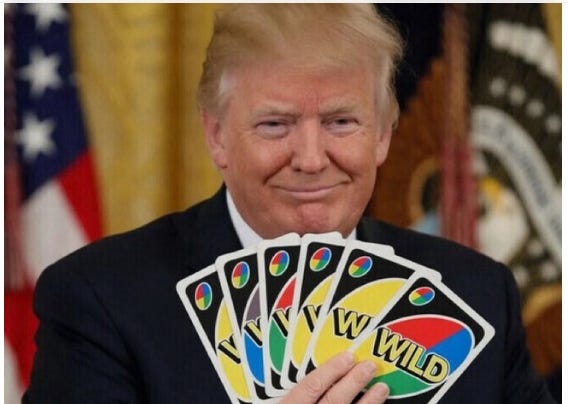
As one recent AI graphic posted by Trump suggests, Trump may be holding a lot of cards, but he’s playing Uno, where having a lot of cards means that you are losing. The Chinese may go easy on Trump, playing the long game, but the U.S. is a good deal weaker now than it was when Trump first started his trade war with them.