

Trump's War
Trump's war of choice is a distraction from bad news at home, but even more a sign of a disturbed psyche looking to rebuild a fragile sense of power as the walls start to close in.

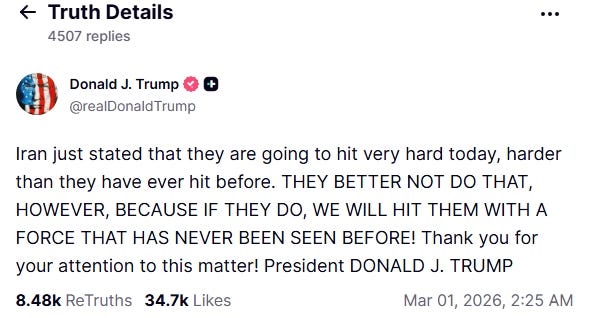
I was hardly surprised when I woke Saturday to the news that the war had started, since everything was pointed in that direction, and Trump’s pattern is to push the button on weekends, maybe to dampen market effects—the June attack and the Maduro event were both weekend events. I had said as much the night before, in a a response to a friend who had emailed a read-out of the Omani negotiators statement that Iran had made significant concessions on nuclear enrichment.
I wrote back that it only increased the pressure on Trump to act, mentioned the weekend thing, and made a joke about the prediction markets. No real joke—I noticed reports that someone had made a lot of money, calling the attack. I didn’t have insider trading with acts of war on my list for 2026, but there you are.
My regular “feed”—all the publications I subscribe to or follow—is surfeited with cognitive dissonance, for me at least. Khamenei is dead, and there were video clips of people in Tehran cheering the news, while the Times produced a second article on the falsehood of Trump’s three main claims about why he had chosen this moment to wage an all-out attack.
Besides the prevarication, a main line of attack against Trump focuses on the “illegality” of his action, but given the precedent of American warfighting since the end of World War II, it’s actually hard to make that case, except in an abstract sort of way.
The amount of power invested in the “Commander in Chief” is a consequence of the Constitution’s design of American governance, just the latest addition to what happens in the U.S. when a president has reckless disregard for anything that came before him—what looked like guardrails turned out to just be suggestions, based on easily violated social norms.
Not arguing here that Congress shouldn’t assert its authority, but even Democrats are divided on how hard to push. Most Americans were against going to war in recent polls, but if one judges Americans by polls and surveys we are generally a poorly informed populace, prone to emotional response rather than reasoning, so perhaps Trump will get the surge of popular support that he is hoping for.
In any case, it doesn’t matter so much what anyone says or does right now. The war is on, and it’s going to continue, basically until Trump is ready to declare victory. A few days ago, it was impossible to know what victory would look like for him, since the reasons for going to war were so vague and contradictory, if not downright false. Now he has told us: the goal is regime change.
*
This is where a writer like me, who loathes Trump and everything he does, but aspires to a sort of clear-eyed rationalism in my analysis, feels a bit of caution. I could easily write a column in which I focus entirely on everything wrong with what Trump is doing right now, from the terrible cost to Iranian civilians to the way he has hollowed out U.S. strategic defenses in the South China Sea, but that doesn’t seem like the whole story.
The problem with war, as has been the truism since at least 1914, is that once it starts there’s no way to know what will happen. Venezuela made it clear that the U.S. military is good at defining military plans and objectives when given clear strategic goals—in that case, simply to capture Maduro with as few casualties as possible. The mission still could have failed, but at least the goal of it was limited and clear. We weren’t trying to occupy the oil fields.
During the weeks that led up to Saturday’s attack, it had seemed to me that the great weakness in Trump’s impulse to war was the flimsiness of the rationale, or rather the complete absence of any discernable rationale.
Neither the nuclear enrichment program nor Iran’s production of short-range and intermediate-range missiles justified an attack, and while the popular uprising against the regime might have justified some sort of action, it had been violently suppressed weeks ago. And of all possible rationales, regime change seemed the most implausible, given how disorganized and underground the opposition is in the security state.
But in the end, regime change was the only way to justify the scope of conflict that Trump wanted, clearly driven at least in part by Netanyahu’s urging, but also by the violence of his own impulse to assert power in the face of stress and defeat.
The military had prepared a range of options for Trump, and it was clear that Caine’s advice had included a sober analysis of the short-term and long-term risks involved at each level of escalation—a news leak that pissed Trump off and demonstrated the Pentagon’s concern about unintended consequences. Trump chose the biggest one, as he is wont to do.
Given the focus on killing Khamenei and the rest of Iran’s leadership along with Trump’s promise that the war may go on indefinitely, it is hard to imagine a broader attack, except maybe an on the ground invasion or a nuclear strike. If nothing else, the U.S. and Israel are forcing a change in regime because the leaders are mostly all dead now, including the most significant one.
It’s impossible to know what will happen next, and that’s where a sort of caution comes in for me. I’ve tried to project different scenarios, just from what I have read about Iran lately and over the years, and there’s one in which some faction of the Revolutionary Guard decides to join forces with more technocratic, reform-minded politicians within the existing leadership and cuts a deal with Trump in a way that wins popular support.
Here’s the sort of deal, along the lines of the one Venezuela cut with Trump: Iran ends its sponsorship of its various proxy armies like Hezbollah and Hamas, formally abandons its nuclear program in exchange for participating in international agreements on nuclear enrichment, and agrees to limits on ballistic missiles, including forgoing development of a long-range missile able to hit the U.S., in exchange for the lifting of Western sanctions and an agreement to do some business with Trump, an infusion of economic support that helps Iran’s new leadership address the economic woes that led to the most recent uprising.
I’m not saying that this sort of scenario has much likelihood, but I do have to believe that there must be some idea within the Trump administration of what they mean when they talk about regime change, and it would have to look something like this. And my caution, before I launch into a more critical analysis, is that one’s odium toward Trump can sometimes obscure whatever small good may have come from his actions.
I’ve seen a lot of conclusions drawn about Trump’s war being a disaster, as it probably will turn out to be. I think it is worth remembering that Iran’s regime really has been an evil in the world and to its own people, and we don’t know yet how all of this will end.
*
Notice that I didn’t say anything about democratic reforms. Realistically, a plan like the one above only works if the most powerful faction in the government—in this case, the 200,000 member Revolutionary Guard—is behind it. It is working so far in Venezuela, where we swapped democracy for oil, leaving the security apparatus intact, apart from a few symbolic gestures. It makes sense to me that the strategists in the White House, such as they may be, are hoping for something like this to emerge.
Or maybe not. Maybe there’s no real plan at all, just the idea of killing the leadership and degrading the military and security apparatus to the point where central control is compromised and some sort of new, more amenable leadership emerges, or else the war continues until some sort of complete surrender—one that might look as much like civil war as anything else.
It may be a mistake to think of Trump as having any concrete purposes at all, apart from being able someday to declare some sort of victory, however much spin that may take. His own purposes, which are worth exploring, may amount to nothing more than an impulse to strike as a show of his power at a time when he is demonstrably weakened across several domestic fronts.
Indeed, it seems possible, even likely, that the contours and extent of the joint Israeli-U.S. attack were shaped by Netanyahu’s strategic calculus rather than any sort of rationale U.S. strategic thinking.
Unlike Trump, who has now placed regime change at the heart of his strategy, Israel has spoken mainly of simply creating a context in which a change of regime might take place. Their primary, articulated focus is on degrading or destroying Iran’s military capabilities, with a particular focus on the ballistic missile capacity that is capable of striking Iran, as well as the Revolutionary Guard and what remains of Iran’s nuclear program.
In particular, the killing of Ayatollah Khamenei and wholesale attack on Iran’s leadership seems like a long-held goal for Israel, which executed that part of the overall strike, in part guided by CIA intelligence. Getting Trump to sign on to this radical step was probably a goal of Netanyahu’s visit to Trump last month, and if Trump had any hesitance in following that lead, it probably had more to do with the warnings of adverse consequences he received from some of his own people, including his military advisors.
Decapitating the Iranian leadership leaves no real downside for the Israeli’s, who have been on a permanent war footing since the Hamas terrorist attack on October 7, 2023, buttressed by about $30 billion in U.S. military aid, including about $6 billion for missile-defense program. From a strategic standpoint, Israel has no more to fear from any successor regime—or a broken state—than it did from the existing regime under Khamenei, particularly given the continuing degradation of Iran’s military capacity.
That can’t be said for the U.S. From a strategic standpoint, none of Trump’s claims about the imminent danger posed by Iran’s nuclear and ballistic missile programs were true, as the New York Times points out. It was a war of choice for Trump, who basically told the nation that Iran had been our enemy and a bad actor since 1979, and he was finally the president to do something about it.
The question of what will follow in Iran now that Khamenei is gone won’t be settled for at least a few days, though right now it is apparent that plans for continuity and succession are in place, and while the regime will have new faces, it probably can withstand any efforts to overthrow it and replace it with the sort of leadership that Trump might have in mind.
Iran’s ability to put down any popular uprising through the wanton slaughter of protestors has been demonstrated, and one assumes that the equivalent of a civil war between factions within the Revolutionary Guard, or between the IRG and the military, would have to take place, with who knows what kind of outcome. The potential for a failed or fragmented state that might be incapable of formal military operations and turns to a program of widespread terrorist attacks instead can’t be underestimated—something like what happened in Iraq during the height of the ISIS state.
While this sort of outcome would leave things no worse for Israel, and perhaps better, it actually places the U.S. in greater danger than it faced under the old regime, given that Iran does not represent a military threat to the U.S. From the strategic standpoint of U.S. interests in the Middle East, there’s no way to say that we would be better off with Iran as a failed state, and the hope for some better regime arising from the ashes seems slim at best.
But the question of whether the U.S. war on Iran is a strategic success or failure in itself is beside the point. Whatever tactical success these days or weeks of war may turn out to be, the decision to go to war was already a grave strategic mistake, one that greatly diminishes U.S. military capacity to counter its actual enemies, Russia and China.
*
It’s far too early in the war to know what the endgame will be, except that it will include some declaration of victory on Trump’s part. That much is certain, and the evidence will be there in the form of how much the bombing and missile strikes reduced Iran’s capacity to attack its neighbors, and how long it will take before whatever new regime emerges to rebuild. Trump already “obliterated” Iran’s nuclear program. Now it will be doubly obliterated, if such is possible.
And these claims of Trump’s, whatever they may turn out to be, may largely or even entirely be true. But the war will still have been a strategic disaster for the U.S., even by the terms of the new 2026 National Defense Strategy, which reorients U.S. strategy to focus primarily on defending the American “homeland,” maintaining hemispheric security (the “Donroe doctrine”) and on deterring China in the Indo-Pacific through strength but not confrontation.
We can’t know what the Pentagon’s advisement of risk was to Trump, and it certainly must have included the potential for casualties and expanded war and instability in the Middle East. But it probably focused on the way in which the war would weaken the ability of the U.S. to counter China around Taiwan and the island chains that mark points of ongoing tensions between China and neighbors like Japan, the Philippines, and Australia.
Furthermore, the U.S. already faces a crisis in terms of industrial production of weapons systems and munitions, particularly in terms of anti-missile systems, which are being drawn down at a rapid rate in both the Ukraine and Israel. Operation Midnight Hammer and the 12-day Israel-Iran war last June, significantly depleted U.S. stockpiles of weapons systems like THAAD interceptors, which are produced largely by hand at a rate of about 15 per year, Patriot and standard missile interceptors, and the nearly irreplaceable GBU-57 Massive Ordnance Penetrators, of which 14 were used, as much as half of the existing stockpile.
Trump has already complained about the sluggish production capacity of the U.S. military industry, singling out Raytheon by name, but the reality is that the industry is tooled for peacetime right now, and can’t quickly ratchet up its production of key systems and munitions.
Most war-gaming in recent years has the U.S. running out of stocks of key armaments within weeks, even days, in case of a large-scale war with China. The capacity to fight an extended war against an equivalent military power was already at risk. If this current war drags on, the situation will only grow more dire.
Beyond that, and more important, the U.S. ability to counter China through strength in the Pacific is gravely impaired, at least in the near term, by the repositioning of carrier battlegroups and other war-fighting assets out of Asia and into the Caribbean and now the Middle East, while troop and equipment rotations have been strained to their limit.
At present, there are only three active U.S. carrier groups, the two in the Iran war and the U.S.S. George H.W. Bush, which has left Norfolk and is steaming in the Atlantic toward the Middle East or the Mediterranean, possibly to replace the U.S.S. Gerald R. Ford, which is almost three months overdue for rotation and experiencing widely reported sewage problems. There is no carrier group in the region around Taiwan, leaving defense of the island nation to land-based air forces and naval allies.
China is already effectively in a permanent war preparation and rehearsal posture with Taiwan, conducting military exercises on an almost daily basis. While most military experts still see a gap between current preparedness and what would be required to execute a full-scale amphibious invasion against Taiwan, Trump’s deployment of the military changes that calculus.
There’s no sign that China is considering taking advantage of the absence of U.S. forces from the Pacific region, and the two nations are still engaged in ongoing talks. Trump has toed a conciliatory line for the most part, after his tariff saber-rattling was checked by Xi’s reminder of America’s rare earths problem. He expects to visit China at the end of March, but the Chinese have yet to agree on a date.
China already has an upper hand in negotiations about trade, partly because of its chokehold on strategic minerals, and partly because it has been nimble in adapting to the new global trade environment created by Trump’s tariff war, a circumstance made only more complicated for Trump by the recent Supreme Court decision. The relative military weakness of the U.S. in the region may not encourage a sudden strike by China, which plays the long game in a way that Trump cannot, but it certainly strengthens Xi’s hand if and when he does meet with Trump.
From the strategic standpoint of U.S. military readiness, Trump’s war on Iran is a disaster. Whatever benefit the war may bring to Israel, and perhaps to other U.S. allies like Saudi Arabia and the United Arab Emirates, it brings none to the U.S., while the corollary consequence of degrading U.S. military capability continues the overall theme of Trump’s presidency of weakening America’s standing in the world.
*
Since the war started I’ve been reading through the flood of news and controversy, and I’m just adding my own little bucket to it here, churning through the obvious and speculating on the unknown just like everyone else. Why is it happening? What does this all mean? What happens next?
Ultimately, I think that the most important answers to those questions lie outside the Middle East, and even outside America’s strategic position in the world. Instead, they all center in the White House. China is not going to invade Taiwan, and when the war ends, the Middle East will be different, but no more relevant to the U.S. than it has ever been. Unless Trump goes entirely insane and puts troops on the ground, we probably won’t be talking much about Iran six months from now.
Part of my point there is that, despite the gravity of it, the war on Iran is a spectacle designed to capture attention away from the increasingly bad news Trump has been facing on other fronts. It’s something presidents do, sometimes. Reagan was a master of it. And, as Timothy Snyder points out, it’s part of the dictator playbook, to start a war in order to unite a nation and use it to cancel elections. I imagine that Stephen Miller has dreamed out the whole scenario, though I doubt that Trump has, since he can’t hold a sequence of things in mind anymore.
The Epstein news is edging closer and closer to Trump, still a bit on the fringes with plenty of other big names taking the fall, but enough so that it is obvious there’s plenty more. Trump’s DOJ is running what Watergate co-conspirator John Erlichman called “a modified limited hangout,” a strategy of mixing partial admissions with omissions and misdirection, and there is clear evidence that material that might damage Trump has been purposely withheld.
According to a January 2026 CNN/SSRS poll, just six percent of Americans are satisfied with the disclosures so far, while about half are not, with the remainder not caring one way or another. The pressure is coming from all sides, and the only strategy Trump has left is to try to run out the clock and hope that the topic finally dies before it jeopardizes his presidency.
So you can say that the answer to why this is happening right now is that Trump needed the distraction, and an open-ended war with Iran was about as good as it gets in that regard. I noticed how beside the point every non-Iran article I glanced at seemed, compared to the sheer weight of the material on Iran. It doesn’t matter how purposeless the war is or how clearly it was intended to distract us—we still have to focus on it.
If you just look at it in those political terms, it’s hard to know how much it will help Trump. He laid no groundwork for it, and he seems to be depending on our age-old, almost ancestral memory of Iran as our own great Satan. Certainly the litany of harms Trump cited in his taped 8-minute announcement sought to evoke that latent anger, running all the way back to the 1979 hostages and through every highlight since then.
We’ll see how that works. Most people didn’t think it was a good idea to go to war, according to pre-war polling, and the mainstream media hasn’t been shy about questioning Trump’s lack of rationale and what the unintended consequences may be. It’s an easy war to call into question, particularly with the lessons of 2003 in mind, as they surely must be at the Times, which virtually sponsored that war.
At the same time, Khamenei’s regime was abhorrent, and the scale of slaughter of protestors in January appears unprecedented—perhaps as many as 30,000 dead. Regime change in Iran is something all Americans would support—assuming that it looked like what the protestors were asking for, and not simply a more vicious version of what existed under Khamenei. So far, politicians have been cautious in their criticism, focused more on legality and Congress’s role than the action itself.
We won’t know about the political fallout for a while, and the distraction itself may not last until spring. Any longer than that, and folks will be asking “why are we in Iran?” In those terms, this will probably turn out to be an episode, not a lasting storyline in the runup to November. One hopes that some good of it may come, but that seems doubtful. Whatever victory Trump claims will probably last as long as the win in Venezuela did. We will be talking again about AI and the economy, Epstein and ICE, soon enough.
*
That’s not the most important point, I think. On February 22, after Trump tariff defeat, I published a piece with this headline: “A Sick and Dangerous Presidency.” This was the subhead: “After his defeat on tariffs, Trump’s psychic needs dictate a strike on Iran.” The piece goes on to tentatively predict a strike this weekend, based on Trump’s use of the phrase “ten days” and a Middle East trip of Marco Rubio’s scheduled for the end of the month, which seemed like a ruse to me, as it turned out to have been.
My main argument in that piece, as it has been from the very start with Trump, is that assigning rational motives to Trump’s actions is a form of sane-washing. Trump suffers from a psychiatric disorder, or disorders, that make focus and concentration difficult for him, while causing him to act in reckless and impulsive ways based on internal states. He’s prey to his moods and has a good deal of difficulty controlling his displays of anger. Whatever rationales come up in various decision-making processes, in the end, he is governed by his instincts, which are driven by his emotions rather than reason.
Under stress, and in the face of losses, individuals with these sorts of personality disorders tend to decompensate, often lashing out in ways that escalate the situation and the stress, rather than de-escalating. The ability to see things clearly and reason may be interrupted by intermittent, transient psychotic states, in which the irrational seems plausible or desirable.
It was clear to me when the Supreme Court said no to Trump’s tariffs that he had suffered a grievous psychic wound, on top of an ongoing series of setbacks across the whole range of his presidency. Reminders of the limits to his power make Trump crazy—something one sees in part in his childish fascination with gold medals and naming things and building huge edifices.
Part of the craziness involves exerting his power in order to feel it inside. The all-out attack on Iran, choosing the most dire option among the several available to him in what was, after all, entirely a war of choice, was a psychic rebalancing for Trump. No one around him—no one rational at least—thought it was a good idea. The risks are high, and the action itself is a stark betrayal of Trump’s ant-war campaign promises, while the purposes and prospective benefits are nearly invisible.
Trump wanted this war—like Greenland, he needed it “for psychological reasons.” So he got what he wanted, because there is no way to stop Trump from doing what he wants when it comes to the military. He is the Commander in Chief. And he is not a rational man. Trapped inside his own fragile, prodigiously inflated sense of self, it seems that only violence can satisfy him now.
I guess the question I have is how much more dangerous the psychotic president will become, as his defeats accumulate and the pressure increases. This is a very dangerous year. So far in Trump’s presidency, every crisis has been self-created. It frightens me to think of what will happen when we face a real crisis, as we inevitably will someday.